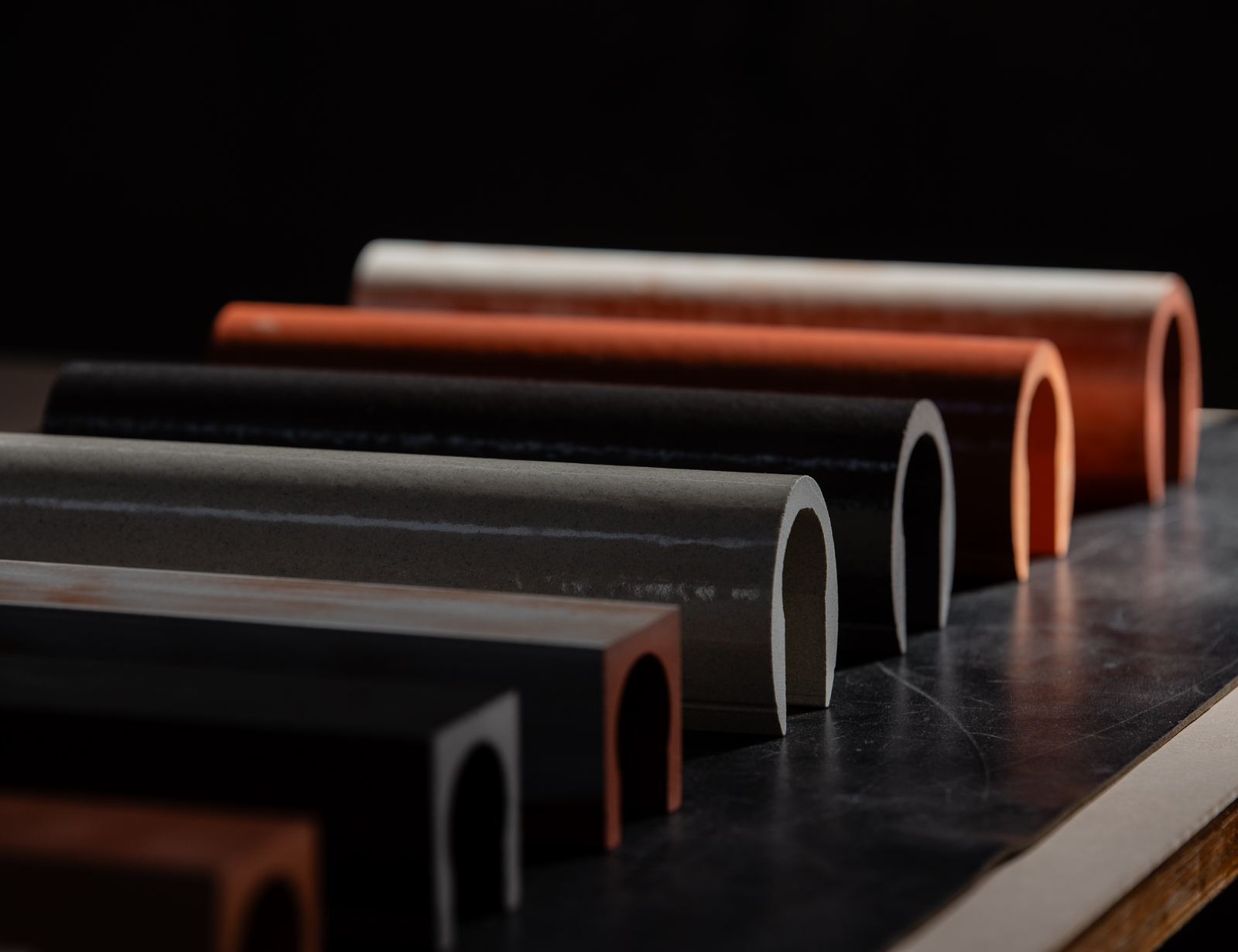
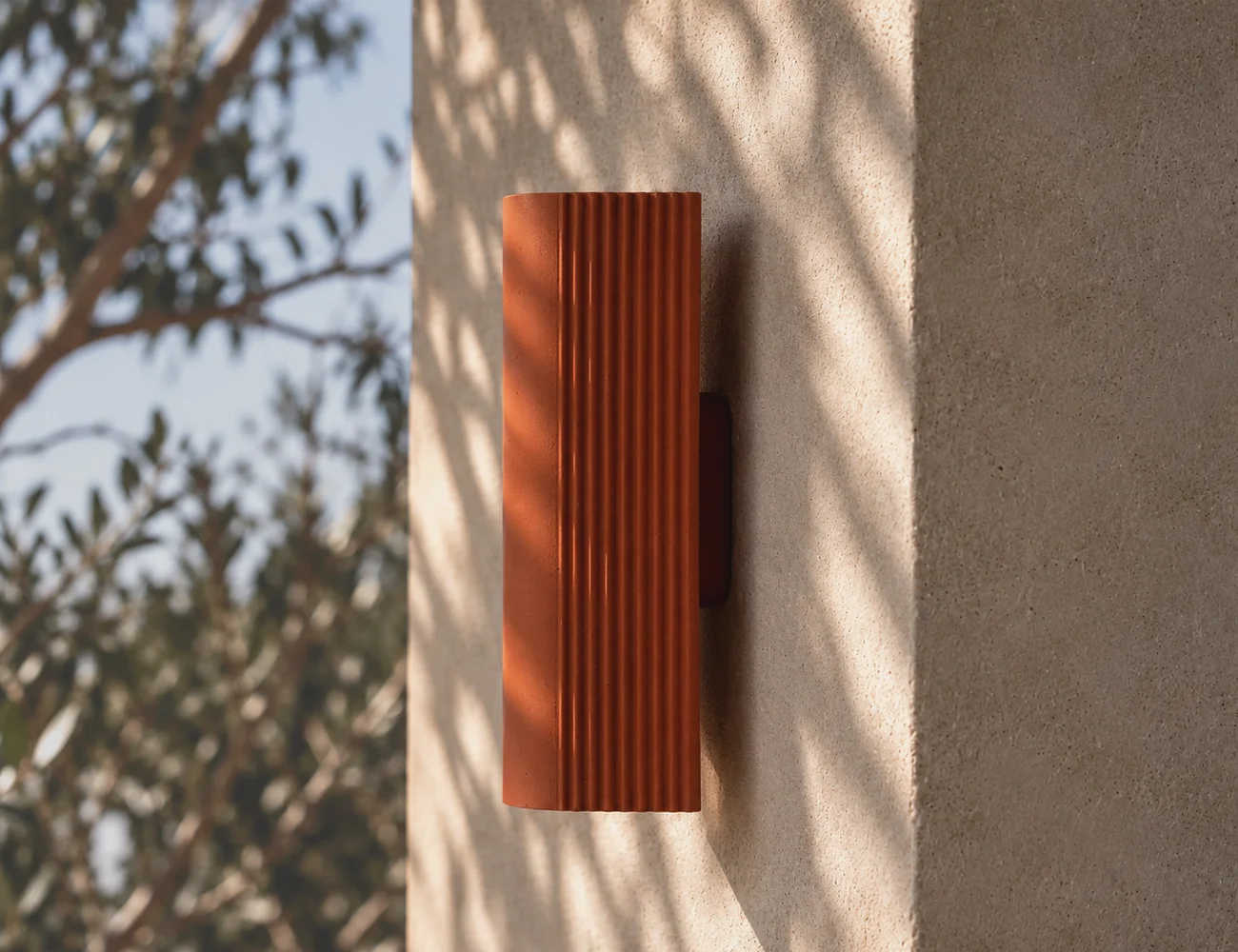
Some materials arrive with their value already in place. Marble is the obvious example. Centuries of use have taught people what it’s worth, so much so that crushed marble set in resin still reads as premium, even though most of what you’re looking at is the resin. Luke Mills, our co-founder and design director, finds that perception interesting. “People understand the value of marble, so it elevates the value of the material,” he says. Macadamia shell has no history like that. As a design material, it is essentially new, and that is what makes it worth looking at.

The material is MACA, developed by Jordi Sanchez of Avant Mater, a material research studio in the Northern Rivers of New South Wales. “I’m an industrial designer by trade, but I’ve always been a maker at heart,” Jordi says. At some point the making itself became the question. “I was making all these things, but I started questioning the materials I was using. I wanted to find a way to make things without feeling guilty about their impact.” That question took him through recycled plastic, cellulose during his time at Zeoform, and hempcrete, the mix of hemp, lime and sand used to build walls, which he worked out how to turn into furniture. From there he moved to agricultural by-products and bio-resins.
Macadamia came from looking at what was close by. “What materials are available close to me that I don’t need to bring in from overseas?” The Northern Rivers is one of Australia’s main macadamia regions, and when Jordi saw the shells, he saw a material. “Macadamia shells are an incredibly hard plant-based material.” The industry already finds uses for its shells, from generating power to making biochar, but a harvest this size produces more than those uses can take. Getting hold of them was harder than expected. “At first, it was surprisingly difficult to find someone willing to give me the shells.” After a long run of farms saying no, a processing company 40 minutes from his studio said yes. That relationship has continued. “Having that relationship means I have a reliable, consistent supply of shells.”

The hardness that drew him in is also what makes the material difficult. Breaking the shells down into a fine aggregate is one of the trickiest parts of the process, and in the finished piece it becomes a strength. Mixed with the binder, the material is “similar in consistency to a thick porridge,” Jordi says, and it is cast into moulds. “Once it’s dry, you can work with it much like timber. You can cut it, sand it, drill it, and shape it using conventional woodworking techniques.”
The binder is made entirely from organic matter, with no plastic resins. It isn’t new either: versions of it have been used for centuries, as far back as the Egyptians. It is organic enough that, if you were feeling adventurous, you could eat it. “It’s made entirely from organic matter, so technically, you could eat it. Although I wouldn’t necessarily recommend it.” The surface was designed to keep its origin visible. “We wanted the material to tell its own story. You can see the little particles of macadamia shell, each with slightly different colours and tones, revealing where the material comes from.”

Jordi had already worked out bowls. Round forms suit the material because “the material holds its shape and handles tension really well.” When Luke saw the work, he thought of Brae. “We thought Brae would be a perfect form to showcase the qualities of this new material,” he says. The undercut at the top of the shade was the challenge, and the rest was a matter of applying what Jordi already knew to a form that already existed. For Jordi, the fit with South Drawn made sense. “South Drawn works with clay, glass and metal. It’s a lighting company with a strong focus on materials and their qualities.”

That focus on materials is where Luke’s interest lies. “Materials in the design process offer limitations. They limit the scope of what you can do with them, and the fun bit is pushing the boundaries of what you can do with the material to create a beautiful end result.” A new material takes that further. “New materials, where there aren’t any rules and there are no expectations of what it looks like or how it should be used, are quite interesting.”
Using the material is only part of the work. The other part is showing its value without decades of reputation behind it. In this case the colour helps. MACA is a rich chocolate brown, a dark, natural tone that holds its place as trends move around it, and one that sits easily alongside timber and other natural materials.
Brae Macadamia is made to order, with a bronze powder coat aluminium bracket, for indoor use.